Projects
Compiling...

Four projects told as short case studies: the problem, what I built and the decisions behind it. A few smaller ones follow.

Projects I built and the decisions behind them

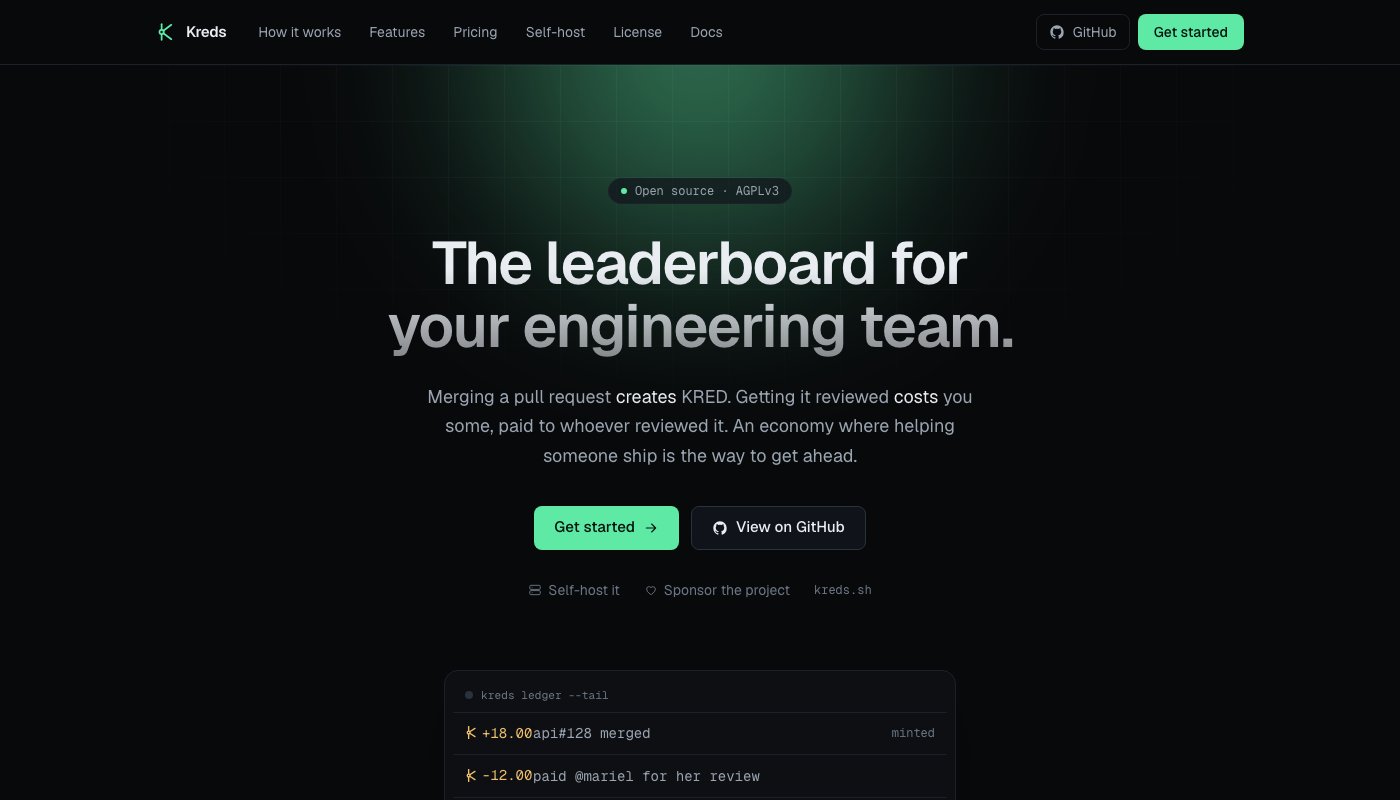
Kreds landing page presenting the leaderboard for engineering teams
Open source Β· AGPLv3

Kreds

Open-source, self-hostable leaderboard and internal economy for engineering teams, built on GitHub activity.

Problem
Contribution graphs reward volume and hide the work that holds a team together: the thorough review, the unblocking, the help that lets someone else ship.
What I built
  • Merging a pull request creates KRED; getting it reviewed costs some, paid to the reviewer. Helping someone ship beats shipping alone.
  • A double-entry ledger is the source of truth: the event pipeline and the ledger came first, and no balance is ever stored.
  • Economic rules are written down as a constitution the code must obey, so every change is checked against explicit laws.
  • A GitHub App feeds merged PRs, reviews and closed issues as input; self-hosting runs on Docker with Postgres and Redis, with no license key.

Meraki Writings home page with its editorial, minimal layout

Meraki Writings

Personal editorial platform for long-form writing and poetry, designed to be read slowly.

Problem
Long-form writing and poetry need a quiet, fast reading experience that generic blog templates and social platforms do not offer.
What I built
  • Built end to end: content model, editorial workflow and front end.
  • Payload CMS as the backend, so publishing never requires a deploy.
  • Performance and SEO treated as requirements from day one, not as a final pass.
  • An editorial, minimal design system with reusable UI components.
Private Β· in progress

ZitStack

The shared platform behind ZitDevs, my studio: identity, payments, billing and invoicing as a modular monolith.

Problem
Every product the studio ships needs the same foundations. Rebuilding sign-in, billing and payments per product multiplies cost and risk.
What I built
  • ZitID gives users one identity across the whole ecosystem.
  • One monorepo: products are separated conceptually before they are separated physically.
  • The API and the worker load the same modules, so business rules live in one place.
  • Modules are added only when a product needs them, not as placeholders.
  • TypeScript
  • NestJS
  • Next.js
  • Turborepo
  • PostgreSQL
cominnek

git switch -c feature/APP-142-login-form

cominnek commit

? Type: feat

? Message: add login form validation

βœ” feat(APP-142): add login form validation

Open source

Cominnek

Open-source Go CLI that writes Conventional Commits linked to the Jira ticket in your branch name.

Problem
At Minnek, the team's commit standard was valuable but tedious: typing the type, scope and ticket by hand led to inconsistent history.
What I built
  • Reads the Jira ticket from the branch name, so nobody types it twice.
  • Guides the commit type and message to produce valid Conventional Commits every time.
  • Shipped as a single Go binary: fast to install and fast to run.

Also built

More projects